By Emily Sohl and Riley Nee
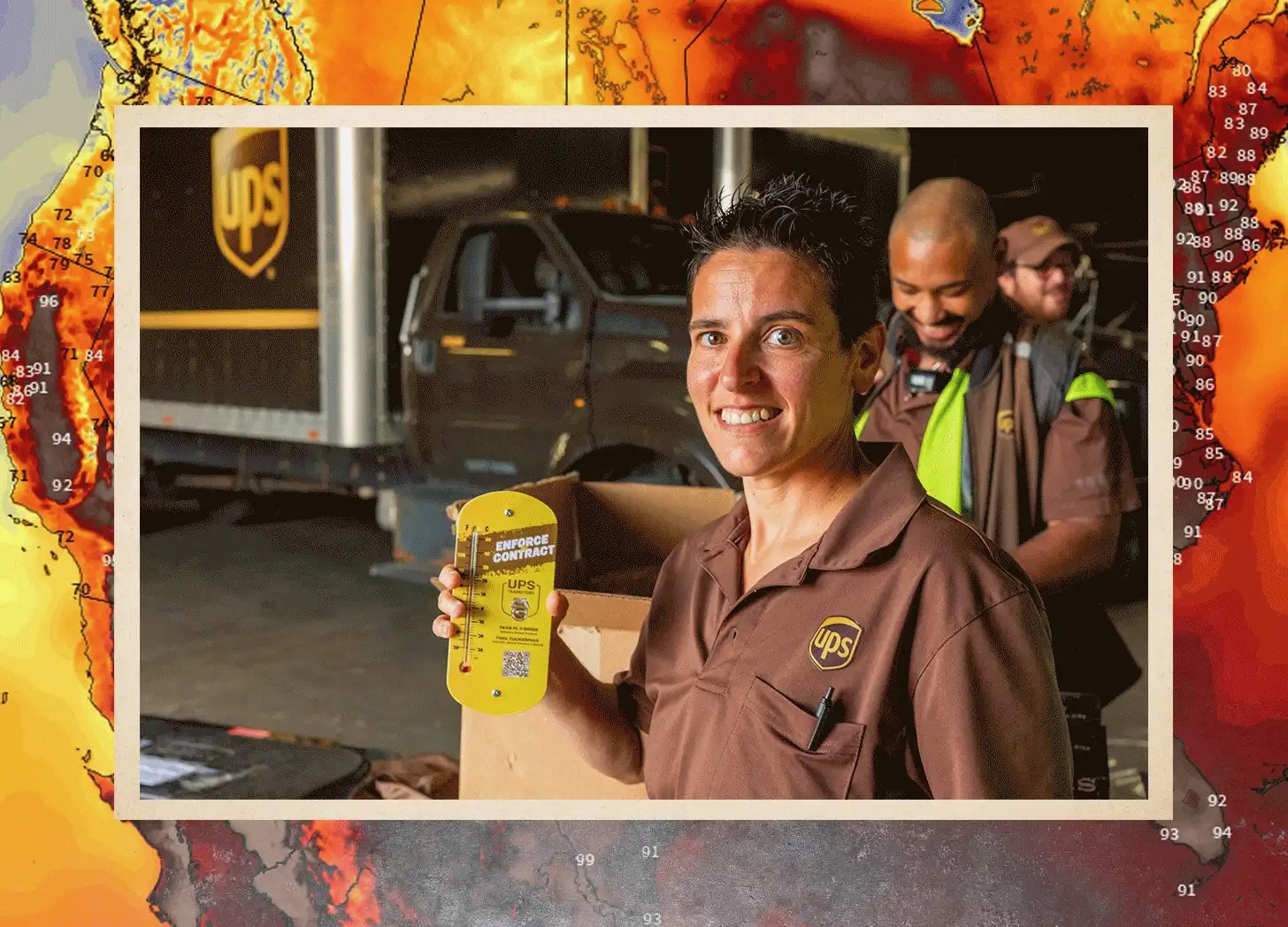
In summer 2025, Cameron Bowman, a United Parcel Service (UPS) package car driver from Teamsters Local 767, began feeling lightheaded and fatigued while working in temperatures above 100 degrees. Inside his package car, the heat was even more intense. Bowman notified management, but his condition worsened, and he eventually ended up in the hospital with heat illness.
Every year, more heat waves make headlines as workers around the world struggle to adapt to increasingly dangerous conditions. UPS Teamsters know that reality all too well. Long days, little rest, and sweltering temperatures can make summer especially dangerous for delivery drivers, particularly in the hottest states.
Fortunately, situations like Bowman’s are becoming less common at UPS — thanks to significant safety measures proposed and secured by Teamsters at the logistics giant.
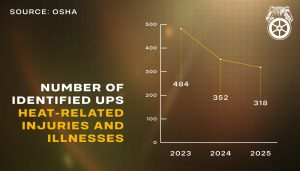
Despite Americans experiencing heat-related injuries at higher rates than ever before, cases at UPS have decreased 35% from 2023 to 2025, according to incidents reported to the Occupational Safety and Health Administration (OSHA).
Does this data suggest that UPS is willfully and responsibly enacting measures to improve safety that other employers are missing? Or is the company being forced, kicked and screaming, to finally do right by its workers?
If you’re a Teamster, you already know the real answer.
In 2023, Teamsters negotiated the historic UPS Teamsters National Master Agreement, protecting 340,000 rank-and-file members. For the first time, this contract with UPS contained explicit heat safety protections and requirements for air conditioning to be installed in delivery vehicles.
“The 2023 contract completely overhauled heat protections. For the first time, heat safety is a real priority, and it’s making a difference,” said Karla Schumann, Teamsters International Western Region Vice President.
Through consistent and robust contract enforcement and by continuing to make heat protections a priority, the Teamsters are committed to get case numbers down to zero. But as the union prepares to launch another national contract campaign in Fall 2027, is UPS management just as committed to worker safety?
The Trucks
Nearly 80 percent of all heat-related injuries at UPS between 2023 and 2025 were reported by Regular Package Car Drivers making deliveries. That’s not difficult to understand when you see the environmental and structural conditions drivers face every day.
Nationwide, UPS drivers routinely work in extreme heat. The interiors of package cars are made almost entirely of metal, with little insulation to keep temperatures down. Drivers often describe the cargo area as an oven, and thermometers provided by the union have recorded temperatures upwards of 140 degrees Fahrenheit during the summer.
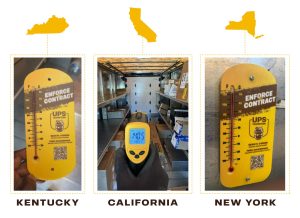
“The interiors of these trucks are scalding,” said Ryan Luu, a package car driver from Local 767 in Texas. “Just this morning, my skin was burned when it touched the floor of the truck as I was picking up a box.”
The 2023 Teamsters contract required UPS to install cab fans, heat exhaust shields to block heat from the floor, and air induction vents in existing package cars.
But the biggest change is air conditioning. Prior to the current Teamsters agreement, UPS took no proactive measures to improve ventilation or reinforce interior heat protections in regular package cars. It was long-standing UPS policy to actually dismantle and remove air conditioning pre-installed by manufacturers before the package giant handed off new vehicles to workers.
But under collective pressure from the Teamsters at the bargaining table, UPS finally agreed to retrofit 28,000 vehicles with air conditioning by 2028, when the 5-year agreement expires. Moreover, the Teamsters pushed UPS to guarantee that air conditioning would be installed in all new package cars purchased from the time the agreement was signed in 2023 — another monumental first.
Bowman’s package car was retrofitted with A/C in March. Since then, he has not been affected by high temperatures.
“Just because we’re in and out of our trucks a lot doesn’t mean A/C can’t make a huge difference,” Bowman said.
Even with the truck doors open, installation of A/C can make up to a 30-degree difference of conditions inside the cab.
Once the current agreement was signed in 2023, Teamsters didn’t simply stop at winning A/C commitments from the company. The union pushed UPS to move faster on A/C-equipped vehicles in states where workers face the most extreme heat. As a result, in 2025, UPS signed a letter of agreement with the UPS Teamsters National Negotiating Committee committing to expedite the retrofitting of 5,000 package cars with air conditioning in what the company and the union call Zone 1 — the hottest delivery zone in the country, comprised of multiple southern and southwestern states.
Under that supplemental agreement, UPS met its first deadline to expedite the delivery of 2,000 package cars with A/C by June 1 this year. UPS is required to speed up the retrofitting of another 3,000 by June 1, 2027.
This is what it looks like when Teamsters fight for heat protections: not just winning stronger contract language but also holding UPS accountable for putting those protections into practice, especially when workers’ lives are at stake.
The Warehouses
The Teamsters fight for worker safety from the heat doesn’t stop with package cars.
Since 2023, UPS is also contractually required to establish designated “Cool Zones” (cooling stations) inside warehouse facilities as well as on delivery routes. In facilities, these stations include access to both clean drinking water and a working ice machine. The company is also required to install and maintain 2,500 new water fountains over the life of the contract.
Warehouses are receiving 18,000 additional structural fans to boost building-wide air circulation. For inside workers, these protections make the difference between an uncomfortable day and a dangerous one.
Krista Longoria, a package car loader and member of Local 480 in Tennessee, said temperatures inside her warehouse have climbed to the triple digits this summer.
“We fought for fans in our facilities and won, and those fans definitely help,” said Longoria.
The equipment matters. But Longoria says another factor matters just as much: making sure workers know they don’t have to simply endure the heat.
“It’s really important that people know when to take breaks and cool down,” she said.
The Right to Cool Down
What has helped solidify the impact of gains won by Teamsters in the 2023 agreement has been education and contract enforcement: teaching Teamsters about their right to protect themselves from heat illness and how to recognize the warning signs.
Article 18 of the 2023 Teamsters contract guarantees workers the right to take a break in a designated Cool Zone whenever they experience symptoms of heat stress.
“I am always telling people that they are allowed to take a break and cool down and drink water whenever they need, as long as they need, to feel better,” said Longoria.
Beyond just spreading this information on the job, Teamsters across the country are organizing heat safety trainings, staffing information tables outside UPS facilities, distributing thermometers, and making sure members understand both the risks of extreme heat and the protections they have under the contract. Bowman works as part of the safety committee for Local 767 to educate and empower his fellow drivers to protect themselves in harsh heat.
“UPS like to say people over packages, but they don’t actually mean it. The company’s not looking out for my best interest, so Teamsters must look out for each other,” said Bowman.
From New York to Southern California, Teamsters are putting that message into action.
“If we don’t take care of ourselves, we might not go home,” said Dave Carew, a package car driver from Teamsters Local 84 in Long Island. “The goal isn’t to reduce heat-related injuries by 35 percent. The goal is zero.”
Recognizing the warning signs of heat illness is one of the most effective ways to prevent a medical emergency.
According to OSHA, the seven most reported symptoms before a heat-related injury or hospitalization at UPS were muscle cramps, dizziness, fatigue, headache, lightheadedness or fainting, nausea or vomiting, and abnormal sweating.
The protections won in the 2023 contract are making a difference, and they work best when workers know how to use them. Better equipment, cooler workplaces, and stronger contractual rights have all helped reduce heat-related injuries. Safety on the job improves when a workforce that knows its rights and recognizes warning signs unites and communicates to look out for one another.
And the Teamsters aren’t stopping anytime soon to improve working conditions for members at UPS. The gains won in 2023 show what workers can accomplish when they organize, bargain collectively, and enforce their contract. As the union prepares for the next national contract campaign, Teamsters will build on those victories and fight for even stronger protections, better vehicles, and safer workplaces.
The 2023 Teamsters National Master Agreement at UPS raised the standard. The next campaign is set to raise it even higher.